
01 / THE OPERATING QUESTION
How do you keep production on the correct BOM revision?
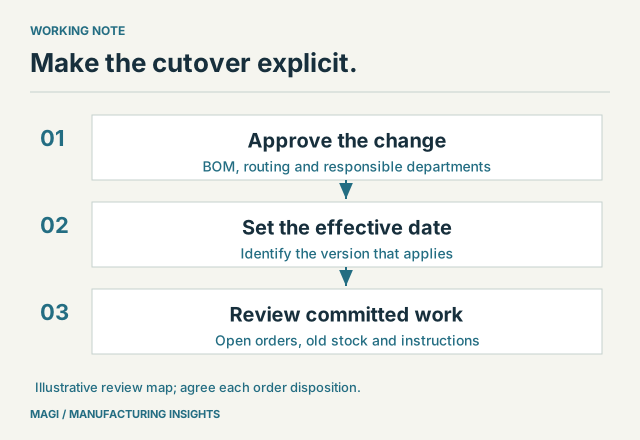
BOM revision control in manufacturing ERP connects an approved product change to an effective date, the affected components and routing, and a clear decision about work already released. A revision label identifies the change. Production also needs to know when to use it, which orders it applies to, and what to do with material built or purchased to the earlier specification.
For an established manufacturer evaluating replacement ERP, that distinction is a useful demonstration test. Ask the supplier to follow a change from engineering approval through a new manufacturing order and an order already on the floor. Both must have an explainable outcome.
Consider a bracket whose mounting-hole pattern changes from revision A to revision B. The new bracket may need a different fastener, a revised drilling operation and a new inspection instruction. Renaming the drawing alone does not resolve those related decisions. The change needs an owner and an agreed production cutover.
02 / THREE DIFFERENT CONTROLS
Separate revision, effectivity and approval
A revision identifies a version of a product or process. Effectivity defines when a component or operation belongs in the applicable structure. Approval establishes that the responsible people have authorized the change. These controls answer different questions; none should be treated as a substitute for the other two.
For example, an engineering change can be approved today for a future production date. Purchasing may need that information now, while an assembly already underway may still require the earlier component. Oracle's manufacturing documentation on revisions and effectivity illustrates why version identification and effective-date rules must be considered together. The precise rules depend on the ERP and its configuration.
MAGI's BOM and routing capabilities include engineering changes, in/out effectivity, revision history and electronic approval. Its ECO workflow separates submission, departmental approval and release. Configured approval sequences can require another department's approval before the next department acts.
03 / INSIDE MAGI
Review the change before releasing its effectivity
In MAGI, ECO release checks the change's status and the user's authorization, then asks for the effective date. The release process applies that date to qualifying BOM and routing changes and updates the associated engineering revisions. It also marks affected items for planning and costing attention. That is a controlled engineering release; the consequences for existing orders still belong in the implementation and operating review.
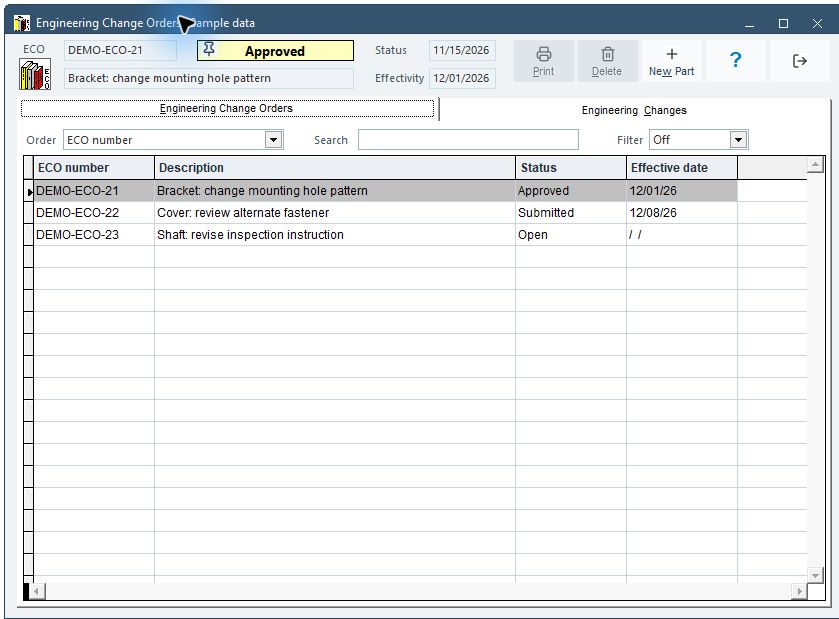
INSIDE MAGI / ENGINEERING CHANGE ORDERS
 Open full-size screenshot ↗
The sample bracket change is approved with a future effective date. A second change is submitted, and a third remains open. Those distinctions give engineering, purchasing and production a more useful conversation than a shared folder containing several files called “latest.” The list is the starting point: the team must also review the affected part, component, operation and instructions.
When evaluating the workflow, ask who can submit, approve and release, how a rejection is handled, and what happens when the effective date changes. Verify the configured approval responsibilities using people from your own organization.
04 / WORK ALREADY COMMITTED
Make an explicit decision for open orders and existing stock
Suppose revision B takes effect on December 1. One order has already been kitted with revision A components; another is due to start after the cutover. There are also unused revision A brackets in inventory. The following is an illustrative review worksheet, not a claim that one release command automatically performs every action.
Include the planner and operator in that review. They need to identify which approved instruction applies to the job in front of them and where to take a conflict. Test that working question with both orders. Clear revision information should help employees act correctly while engineering and release permissions remain in force.
Scroll the table to see all columns →
| Affected work | Decision to record | Evidence to inspect |
|---|---|---|
| New order after the cutover | Use the intended effective BOM and routing. | Order material and operations match the approved revision. |
| Order already kitted | Finish to A, rework to B, or hold pending disposition. | Authorized order-specific instructions and physical material agree. |
| Old component stock | Use where permitted, segregate, rework or dispose of it. | Inventory status and location support that disposition. |
| Open supplier order | Confirm which specification the supplier will deliver. | Purchasing has an accepted revision and delivery commitment. |
| Inspection and drawings | Identify the instruction that applies to each affected job. | The operator and inspector can find the same approved requirement. |
Do not assume a BOM edit silently rewrites every released manufacturing order. Demonstrate how your chosen process reviews and changes open work, and reconcile the result. Our production scheduling guide explains why material, operation and capacity assumptions also need to remain consistent.
05 / A REPEATABLE REVIEW
Use a short engineering-change checklist
- Scope: identify the parent item, changed components, routing operations, drawings and inspection requirements.
- Reason: record what problem the change addresses and which products or customers are affected.
- Approval: name the departments and people responsible for the decision and the release.
- Timing: establish the effective date and test the structure immediately before and after it.
- Committed work: review open manufacturing orders, purchase commitments and allocated material separately.
- Disposition: assign a decision for old stock, work in process and rework.
- Confirmation: check what the operator sees and retain the decision history.
A useful acceptance test includes an attempted release by someone without the required authority and a change awaiting another department's approval. It also includes a legitimate exception, such as completing a particular order to the earlier revision. Record what was shown, what requires configuration and who owns any additional work.
06 / YOUR ERP EVALUATION
Bring one difficult change to a MAGI demonstration
Choose a real type of change your team struggles to coordinate, using sanitized sample records. Bring the before-and-after BOM, the intended date, an open order and a small amount of old stock. Ask to follow the engineering decision through production preparation and the handling of that existing work.
MAGI combines manufacturing depth with business consulting included in onboarding and available to customers as their processes develop. Use the implementation checklist to turn this demonstration into a documented acceptance scenario. The objective is an affordable ERP implementation that preserves the manufacturing controls your business actually needs.
Sources & article notes
Prepared by MAGI Manufacturing Insights with AI-assisted research and writing. Product coverage was checked against MAGI information and available software evidence. Numerical examples are illustrative, not customer results. Available options depend on the implementation. Read our editorial process.