
01 / DEFINE READINESS
Go-live readiness should be observable
A manufacturing ERP implementation is ready when the records, people and operating steps work together well enough to support the agreed launch. A completed installation or a calendar date is only part of that evidence.
Start with the launch boundary. Identify the company or sites, functions, items, open transactions and external connections that belong in the first operating scope. Make later phases explicit so the team does not confuse a future objective with a requirement for the first day.
MAGI’s published implementation sequence includes data conversion, training, review of process fit, hands-on practice, tailoring, another conversion and go-live support. Use those stages to organize concrete deliverables and responsibilities. The amount of work depends on your data and scope; it should not be assumed from a generic implementation-duration claim.
02 / PREPARE THE RECORDS
Give each data set an owner and an acceptance check
Assign the business owner before the first conversion. The person who can explain a record is often best placed to recognize a wrong result. A technically successful import does not establish that an item’s purchasing unit, revision or remaining order quantity is correct.
| Data set | Review before conversion | Check after conversion |
|---|---|---|
| Items and units | Duplicates, obsolete codes, units and supply policies. | Representative items and unit conversions. |
| Bills and routings | Revisions, effectivity, component quantities and operations. | Selected product structures and planning/costing results. |
| Inventory | Locations, holds, lots/serials where used, and cutoff quantities. | Agreed quantity and value totals plus sample detail. |
| Open orders | Remaining quantities, dates, partial receipts and shipments. | Outstanding commitments at the agreed cutoff. |
| Accounting balances | Control totals, open items and reconciliation ownership. | Agreed balances and representative supporting records. |
Keep a correction list with an owner and a status. Do not repeatedly edit the converted copy while leaving the source problem unexplained. Agree whether each correction belongs in source cleanup, conversion logic or a documented setup step.
03 / REHEARSE THE CONVERSION
Use a trial to test meaning as well as format
MAGI’s import tools include validation for required values and existing records, and bill-of-material checks include circular-reference handling. Those controls are useful, but they cannot decide every business ambiguity in a legacy record.
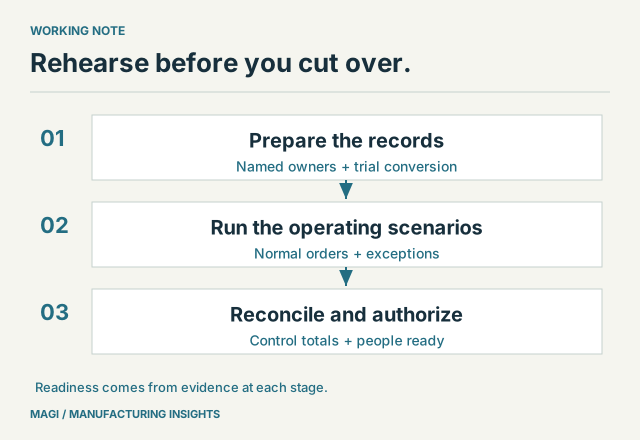
A trial conversion should therefore include business review. Follow a partially received purchase order, an item with a nontrivial unit conversion and a product with a recent revision. Reconcile the totals agreed for the trial. Record exactly what must change before the next conversion.
Define how historical information will remain available. Some history may need to be active in MAGI; other material may be retained in an accessible archive. The answer should follow the operational need and the agreed conversion scope, rather than an assumption that every historical record can be imported unchanged.
A practical conversion result: the agreed control totals reconcile, the representative difficult records have been reviewed, and every remaining exception has an owner and a disposition.
04 / TRAIN THROUGH THE WORK
Have people complete the same order together
Role-based practice is more useful when it follows a connected transaction. Sales enters the order, planning reviews supply, purchasing handles a requirement, production records work, the warehouse ships and accounting reviews the resulting records.
Introduce an exception during the rehearsal. A component arrives late, a customer changes the quantity, or part of a shipment is held. Each user should know both the system step and the person who owns the next decision.
MAGI describes training that combines system fundamentals with pilot experience and customer-specific needs. Identify internal people who can reinforce that knowledge and help colleagues after launch. Attendance at a class is different from demonstrating that a user can complete the required task.
- Normal orderEvery role completes its work and the records remain connected.
- Shortage or changed dateThe team finds the issue and follows the agreed decision path.
- CorrectionA mistaken entry is handled using the supported process and permissions.
- External connectionAn import, update or shipment exchange is checked, including an exception.
05 / CONTROL THE CHANGEOVER
Agree on the cutoff and the release decision
Write a cutover sequence that states when source activity stops or is controlled, when the final conversion occurs, who reconciles the result and who authorizes normal use of the new system. Include the physical work that continues while records are being moved: receiving, production and shipping need clear instructions.
Define how the team will respond if a required check fails. A contingency is useful only when its decision point, responsible person and data implications are understood in advance. Avoid allowing both systems to accumulate independent transactions without a clear reconciliation method.
After launch, maintain a short issue list that distinguishes training questions, record corrections, configuration issues and software problems. Assign ownership and priority based on the effect on work. Revisit operating scenarios when a fix or process change affects another department.
06 / REVIEW THE EVIDENCE
Use a launch checklist with named owners
MAGI implementation readiness
0 of 6 checked. Your checks stay on this page only.
Whether this is a first manufacturing ERP or a replacement system, the same principle applies: readiness is demonstrated through records and completed work. MAGI’s implementation team supports customers making that transition into MAGI.
Sources & article notes
Prepared by MAGI Manufacturing Insights with AI-assisted research and writing. Product coverage was checked against MAGI information and available software evidence. Numerical examples are illustrative, not customer results. Available options depend on the implementation. Read our editorial process.