
01 / DEFINE THE REASON
Name the work the current system makes difficult
Replacing manufacturing ERP is a business decision with a large operational footprint. The strongest case starts with recurring work: orders that require reentry, shortages that are discovered too late, reports that must be rebuilt outside the system, or a sales channel that does not fit the existing process.
Describe each issue as an event with a consequence. “When the customer changes a quantity, the planner must update three separate records” is specific enough to demonstrate. “The system is old” does not tell a replacement provider what has to improve.
Record frequency and impact using your own evidence. Separate a process that nobody owns from a function the software cannot perform. Both may need attention during an ERP replacement, but they call for different work and different estimates.
02 / COMPARE THE SAME SCENARIOS
Ask each provider to work through the same order
Give the shortlist the same manufactured item, bill of materials, customer requirement and exceptions. Keep the scenarios small enough to follow, but include the details that are central to your business: a lot-controlled component, a subcontract service, a customer-specific price or several shipping locations.
Start with the normal path. Then change something. Move a receipt date, reduce an order quantity, split a shipment or introduce a production variance. A replacement has to support the questions people ask after an order stops being routine.
| Requirement | What to record |
|---|---|
| Daily transaction | The steps shown, the role performing them and the resulting records. |
| Exception | How it is found, who can resolve it and what remains visible afterward. |
| Company-specific workflow | Existing configuration, supported customization, additional development or an unresolved gap. |
| Reporting | The data behind the answer and whether the user can reach the underlying transaction. |
| External connection | The exact information exchanged, direction, timing and responsibility for failures. |
MAGI’s order-processing scope includes customer terms, pricing, credit checks, order history and connections to allocation, shipment and invoicing. Use those functions as part of a complete scenario. A screen showing the right field is useful evidence only when the workflow around it also fits.
03 / SCOPE THE DATA MOVE
Decide what must be active on the first day
Data conversion is more than transferring an item list. The new system needs a coherent starting position: usable master records, stock quantities and values, open sales and purchase orders, work in progress, and agreed accounting control totals.
Historical information needs a separate decision. Some records must remain available for service, traceability or comparison; some may be retained in an accessible archive instead of becoming active transactions in the replacement system. Define the access requirement before assuming that every legacy record should be loaded into the same place.
For every data set, record the source, cleanup owner, conversion method and acceptance check. A successful import count is not enough. Reconcile a meaningful business total and inspect representative records, including an awkward case.
Example acceptance statement: “Open purchase quantities and due dates reconcile to the agreed cutoff, and partially received orders retain the correct remaining quantities.” The cutoff and expected result should be agreed before the trial conversion.
04 / EXAMINE THE SUPPORT MODEL
Make configuration and ongoing ownership visible
Manufacturers often develop useful operating practices over many years. Identify which ones represent an essential business requirement and which are workarounds for the old system. Recreating every workaround can make a replacement more complex without improving the work.
MAGI provides configurable screens and reporting and supports customer-specific extensions. Its published implementation approach includes pilot work and review of process fit. Ask the team to classify your requirements and explain who will maintain each change after launch.
The proposal should identify software scope, conversion work, training, configuration, interfaces and any custom development. Discuss how questions are handled during the pilot and after go-live. Avoid evaluating the purchase price without the work required to reach a dependable operating state.
05 / MAKE THE DECISION REVIEWABLE
Keep open requirements separate from demonstrated fit
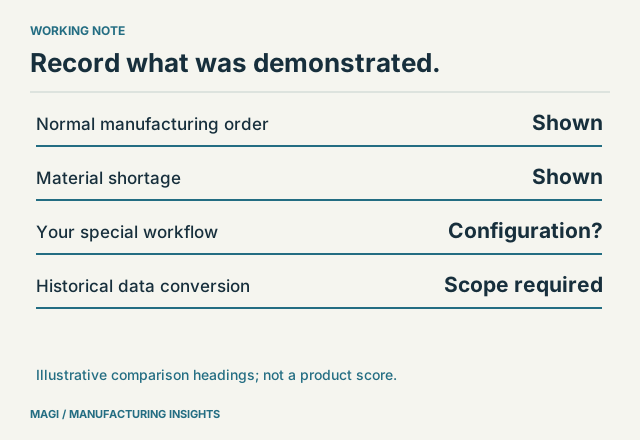
A useful comparison ends with a short record for each requirement: demonstrated, dependent on configuration, dependent on development, or still unresolved. Add the evidence and the person responsible for the next answer. This keeps an attractive presentation from turning an assumption into an accepted capability.
Then rehearse the transition at a realistic scale. A planner, warehouse user and accounting user should be able to complete their part of the same scenario. Their observations often reveal a missing handoff that a department-by-department review would overlook.
If multiple online channels are part of the reason for moving, include them explicitly. The Channel Hub operating guide covers channel identity, stock and fulfillment. The configuration guide helps separate types of change, and the implementation checklist turns the selected scope into a readiness plan.
MAGI’s consulting and implementation work supports manufacturers adopting and using MAGI. The replacement discussion should establish whether MAGI fits the business and what it will take to put that fit into practice.
Sources & article notes
Prepared by MAGI Manufacturing Insights with AI-assisted research and writing. Product coverage was checked against MAGI information and available software evidence. Numerical examples are illustrative, not customer results. Available options depend on the implementation. Read our editorial process.