
01 / DEFINE THE COMPARISON
Ask what produced the cost, not just what the total is
A product cost is more useful when the business can explain its components. Material, labor, overhead, scrap and purchased services can move for different reasons. A single total may signal a problem without showing where anyone should investigate.
When evaluating manufacturing ERP, begin with the question you need answered. Are you reviewing a planned cost before a quote, comparing a completed production order with its expectation, or investigating why the same product costs differently across runs? The records and assumptions behind those answers should be visible.
Keep the comparison consistent. A change in output quantity, product revision or included cost categories can create a difference that looks like production inefficiency. Establish the common basis before drawing a conclusion.
02 / A WORKED COMPARISON
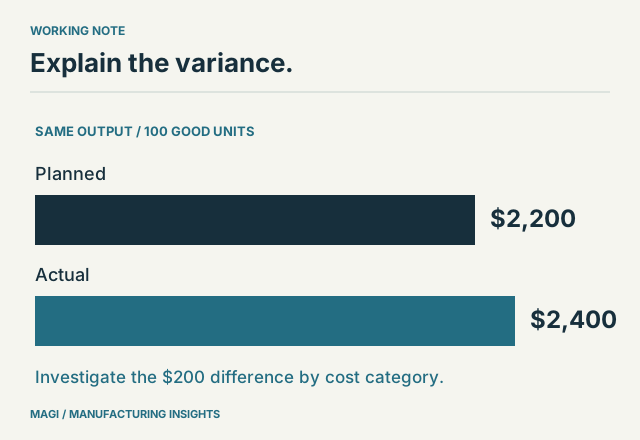
Explain a $200 difference on 100 good units
Assume two views of the same hypothetical production order: the plan and the recorded actual result. Both refer to 100 good units, the same product revision and the same four categories below. For clarity, the example does not separately model scrap, work in progress or an inventory valuation transaction.
| Category | Planned | Actual | Difference |
|---|---|---|---|
| Material | $1,200 | $1,320 | +$120 |
| Labor | $600 | $660 | +$60 |
| Overhead | $300 | $330 | +$30 |
| Purchased services | $100 | $90 | −$10 |
| Total | $2,200 | $2,400 | +$200 |
| Per good unit | $22 | $24 | +$2 |
The total difference is $200, but the next questions concern the rows. Did material cost more per unit, did the order consume more material, or did the product structure change? Did labor hours increase, did the rate change, or was an extra operation recorded? Was overhead applied using the expected basis?
A useful costing demonstration follows at least one difference to its underlying quantity, rate or transaction. If the result can only be exported and reconstructed elsewhere, include that effort in your software evaluation.
These numbers explain a comparison method. They are not a customer result, a savings forecast or a recommendation for a particular accounting policy.
03 / UNDERSTAND THE METHOD
Costing methods answer different operating needs
Standard costing provides a defined benchmark against which activity can be compared. Actual and average approaches use recorded cost information in different ways. A hybrid arrangement applies different methods where the configured rules permit them. The right demonstration explains which method is in use and how that choice affects the record being reviewed.
MAGI documents standard, actual, average-actual and hybrid costing. Its hybrid logic can resolve the method at the item level. Product costing also includes comparisons, simulations, rollups and order variance analysis, with categories such as material, labor, overhead, scrap and purchased services.
Bring a product whose costing treatment matters to your business and ask to see the method explicitly. Then ask how the relevant settings are maintained and controlled. The controller and production team should agree on what the comparison is intended to explain.
04 / CONNECT THE PRODUCT STRUCTURE
Check the bill, routing and outside operations
A manufactured item may contain subassemblies as well as purchased components. Its expected cost depends on the product structure, quantities and routing standards used in the rollup. A missing outside operation or an obsolete quantity can create a misleading baseline before production starts.
Use a simple multilevel item for the demonstration. Change a component cost or a labor standard in a controlled example and follow its effect through the rollup. Ask which revision and effective assumptions are being used. Separate a what-if calculation from a change that updates the operating standard.
Then return to the completed order. Verify the output quantity and the transactions that contribute to the actual result. If scrap is material to your business, demonstrate how its quantity and cost appear. Do the same for purchased services rather than burying them in a broad unexplained total.
Keep two questions visible: “Was our original expectation sound?” and “What happened during this order?” A variance can reflect either an inaccurate baseline or a real operating difference.
05 / EVALUATE THE ANSWER
Bring one product and one variance you want to explain
- Common basisAgree on the item, revision, output quantity and included categories.
- MethodIdentify the costing method and the settings that govern it.
- RollupFollow component and routing information into the planned cost.
- Actual detailTrace a difference to the contributing quantities, rates or transactions.
- ResponsibilityAssign ownership of standards, reporting and corrective action.
Costing is a strong demonstration topic for both first-time buyers and manufacturers considering an ERP replacement. It connects product definition, production reporting and financial review in one scenario.
The scheduling guide examines time and capacity assumptions, while the inventory guide examines material commitments. A MAGI costing demonstration can show how the relevant records support the questions your business needs answered.
Sources & article notes
Prepared by MAGI Manufacturing Insights with AI-assisted research and writing. Product coverage was checked against MAGI information and available software evidence. Numerical examples are illustrative, not customer results. Available options depend on the implementation. Read our editorial process.