
01 / ASK ABOUT THE ORDER
A large inventory balance can still leave an order short
A warehouse can be full while production waits for one inexpensive part. Total inventory value describes the money represented by stock. It does not establish whether the right components are usable, uncommitted and available before a particular operation starts.
When shortages recur, start with an order or product. Identify its component quantities, the date each is required and the stock that can actually be used. Then inspect the supplies expected before that date. This gives the investigation a boundary that a company-wide stock total cannot provide.
The distinction matters when choosing manufacturing ERP. A stock inquiry, an allocation inquiry and a dated supply-and-demand view answer different questions. Buyers should see how the system connects those views without treating them as interchangeable.
02 / WORK THROUGH THE COMPONENTS
Ten assemblies, six missing brackets
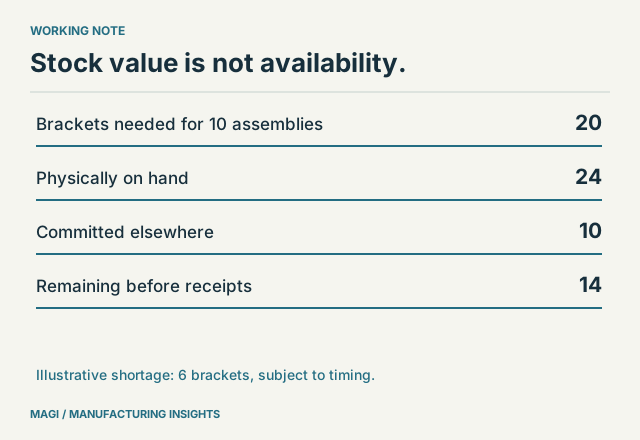
Consider a hypothetical order for ten assemblies. Each requires two brackets, one housing and four screws. Assume stock placed on hold cannot be used for this order, and existing allocations belong to other demand.
| Component | Required | On hand | Held | Committed elsewhere | Remaining |
|---|---|---|---|---|---|
| Bracket | 20 | 24 | 0 | 10 | 14 |
| Housing | 10 | 12 | 2 | 0 | 10 |
| Screw | 40 | 60 | 0 | 4 | 56 |
The bracket row is six short. The extra screws do not resolve it, and the two held housings should not be counted as freely usable. If a purchase order will deliver ten brackets after assembly is due to start, the quantity is promising but the timing still requires a decision.
The planner may need to move the receipt, change the production sequence, authorize a valid substitution or revise the commitment. Those actions need the facts behind the shortage and the authority to make the change. A single red shortage indicator is only the beginning of the investigation.
This arithmetic illustrates an operating question. It is not a report from a customer or a claim that every MAGI inquiry uses this exact definition of availability.
03 / REVIEW THE POLICIES
Look for the settings that create repeated excess
Repeated shortages and excess can come from different causes. An incorrect lead time makes supply appear feasible when it is not. A purchase multiple can create a deliberate surplus. A stale bill of materials can direct purchases toward a component that production no longer consumes.
MAGI inventory settings include safety stock, reorder controls and order minimum, maximum and multiple rules. Safety stock can be expressed through quantities or days of supply. Those controls should reflect the item and its supply pattern; copying one policy across all items deserves scrutiny.
Suppose net demand is 90 units and the vendor supplies multiples of 50. A suggestion for 100 may be reasonable. If the buyer instead sees 150, examine the minimum, existing supply, safety-stock target and unit conversion before assuming the planning engine is wrong. The objective is to explain the quantity.
Record the units as carefully as the numbers. Buying one case and consuming one piece requires a reliable conversion. A lead time or order multiple attached to the wrong unit can create a larger problem than a counting error.
04 / FOLLOW SUPPLY AND DEMAND
Ask the software to explain a shortage
Use the bracket example as a demonstration script. Start from the manufactured item and find the component requirement. Inspect stock by location, existing commitments and outstanding purchase quantities. Move the expected receipt beyond the requirement date and examine the result.
MAGI’s planning and purchasing functions connect dated demand with supply and planner review. In the software, outstanding purchase supply is considered separately from received quantity, and planning messages can call for actions such as rescheduling or reducing an order. The planner still needs to understand the reason and approve the appropriate response.
- Trace the requirementWhich customer or production need is asking for the component?
- Explain usable stockWhich location, hold or commitment changes what can be used?
- Inspect dated supplyHow much remains due, and will it arrive in time?
- Review the proposed actionWhat can the planner change, and what must the buyer or production team confirm?
05 / ESTABLISH A REVIEW ROUTINE
Use recurring shortages to improve the records
After an urgent shortage is resolved, retain its cause. Was the balance wrong, the receipt late, the policy inappropriate or the requirement missing? Repeating the same emergency without correcting its source makes inventory investment difficult to control.
Review a small set of recurring shortage items alongside selected excess items. Assign an owner to policy changes and confirm them with purchasing and production. The purpose is a reliable planning record, not simply a lower stock number.
For first-time buyers, the MRP example explains how those records produce a material suggestion. If inventory also serves online channels, review the channel availability and allocation discussion so consumer promises reflect the same operating commitments.
Sources & article notes
Prepared by MAGI Manufacturing Insights with AI-assisted research and writing. Product coverage was checked against MAGI information and available software evidence. Numerical examples are illustrative, not customer results. Available options depend on the implementation. Read our editorial process.