
01 / THE PLANNING QUESTION
What needs to be available, and when?
Material requirements planning, or MRP, translates demand for products into requirements for the materials used to make them. It considers the product structure, usable supply, existing commitments and dates. The result gives the planner a basis for deciding what to buy, make, move or review.
When the same component appears in many products, a change to one order can affect material and supply across the operation. MRP gives planners a structured way to review those relationships as order priorities, receipt dates and production requirements change.
MRP depends on the meaning of the records it receives. A perfectly calculated suggestion from an obsolete bill of materials or an unrealistic lead time is still a poor plan. The demonstration should expose both the calculation and the inputs the business must maintain.
02 / A WORKED EXAMPLE
Turn 100 kits into a bracket requirement
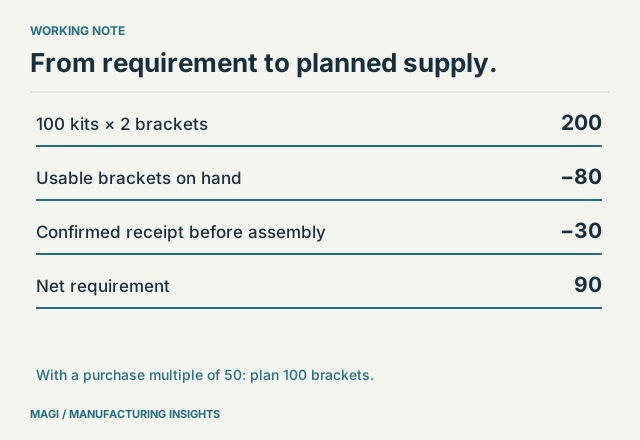
Assume an order requires 100 kits, each containing two brackets. No finished kits are available. There is no other bracket demand in this example, 80 usable brackets are on hand, and a confirmed receipt of 30 will arrive before assembly needs them.
| Step | Quantity | Reason |
|---|---|---|
| Gross component requirement | 200 | 100 kits × 2 brackets per kit |
| Subtract usable stock | −80 | Available for this requirement |
| Subtract scheduled receipt | −30 | Confirmed before the component is needed |
| Net requirement | 90 | 200 − 80 − 30 |
| Apply assumed purchase multiple | 100 | Round up to a multiple of 50 |
The planned purchase of 100 would leave ten brackets beyond the stated requirement. That surplus is explained by the assumed order multiple. It is not an unexplained forecasting error.
Now move the existing 30-unit receipt to after the assembly requirement. If that receipt cannot be advanced, it no longer solves the immediate shortage. The planner must review the timing and the appropriate supply action. Buying more without examining the late order may leave excess inventory afterward.
This is simplified arithmetic, not a MAGI planning run. It excludes other demand, safety stock, scrap, substitutes and overlapping orders so the reasoning is visible.
03 / ADD THE DATES
Work backward from when the component is used
A customer delivery date is not always the component’s required date. Purchased parts may be needed before assembly, and a component used late in a routing may have a different timing requirement from one consumed at the beginning.
Establish manufacturing and purchasing lead times, receiving requirements and any inspection or outside processing that must occur before use. Then examine whether the planned release or receipt dates are achievable. A suggestion to release an order in the past requires attention; the software cannot recover elapsed time.
MAGI’s bill-of-material and routing information includes revision/effectivity controls, standards and lead-time offsets. Its documented MRP scope includes demand from orders and forecasts, inventory policies and warehouse or project planning. Those capabilities make the quality of the product structure and planning settings central to the result.
Keep material feasibility separate from capacity feasibility. All the required brackets can be available while the assembly work center is already fully loaded. The scheduling example shows why both checks matter.
04 / REVIEW THE OUTPUT
A planned action still needs a decision
A useful planning screen should help the planner answer why an action is suggested. Which demand created it? What existing supply was considered? Which date, quantity or policy is responsible for the difference?
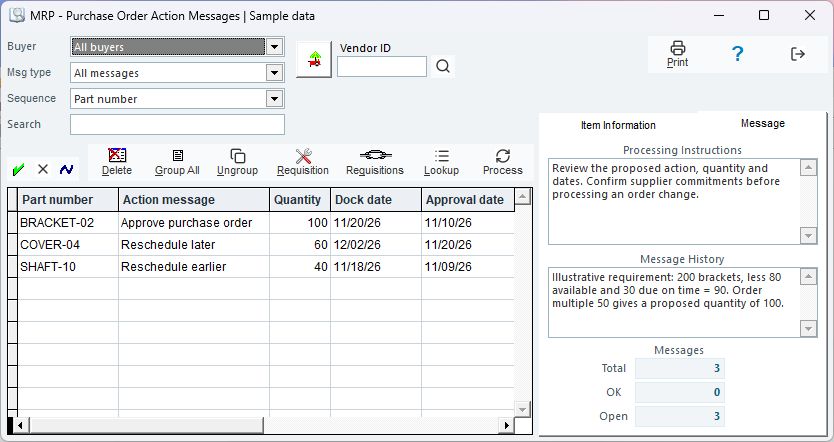
MAGI supports full-regeneration, net-change and perpetual planning modes. Its supply-and-demand review includes messages for actions such as rescheduling, approval, cancellation, quantity reduction and manual review. These are operational decisions, not a promise that every recommendation should be sent directly to a vendor.
INSIDE MAGI / PURCHASE ORDER ACTION MESSAGES
 Open full-size screenshot ↗
Read across the row: the action message identifies the decision, the quantity identifies its size, and the dock and approval dates put it on a calendar. The sample also includes orders that need to move earlier or later. Reviewing those exceptions can matter as much as creating a new order.
For the bracket example, ask to see the effect of changing the receipt date, order multiple and demand quantity one at a time. The person evaluating the software should be able to explain the changed result. That is stronger evidence than watching a planning run finish without an error.
Keep a planning assumption sheet: demand quantity, BOM revision, stock available to the example, dated open supply, lead times, safety-stock policy and order multiple. It gives the team a common explanation when the result changes.
05 / PREPARE YOUR OWN EXAMPLE
Choose an item with one shared component
Bring a manufactured item that your planner knows well. Include a component used in another product, an outstanding purchase order and a realistic due date. Start with a normal result, then introduce a late receipt or increased demand.
Agree who maintains each input after implementation. Engineering may own the product structure, purchasing the vendor lead time, and planning the inventory policy. The handoff matters because MRP recombines their decisions.
Read the shortage investigation for a component-level stock example. For your MAGI demonstration, use the same approach with your own product and ask to follow the recommendation into the purchasing or production review that will act on it.
Sources & article notes
Prepared by MAGI Manufacturing Insights with AI-assisted research and writing. Product coverage was checked against MAGI information and available software evidence. Numerical examples are illustrative, not customer results. Available options depend on the implementation. Read our editorial process.