
01 / MAKE THE REQUIREMENT SPECIFIC
Describe the work before asking for customization
Manufacturers use the word customization for very different requests. One team wants its own label on a field. Another needs an extra column on a document. A third needs a new approval or integration process. Those changes have different scope, risk and ownership.
Begin with the operating requirement. Who is performing the task? What information do they need? What decision or output changes? A sample order, report or manufacturing worksheet gives the provider something concrete to evaluate.
Also identify why the current process exists. It may represent a customer requirement, a useful control or a workaround for older software. Preserving the business need is more important than automatically reproducing every old screen or keystroke.
02 / CLASSIFY THE WORK
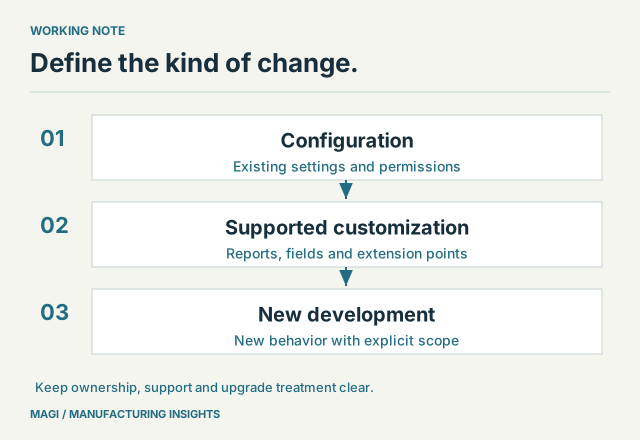
Separate configuration, supported customization and development
| Type | Typical question | What to establish |
|---|---|---|
| Configuration | Can an existing setting, permission or layout option handle the need? | Who can change it, where it applies and how the result is checked. |
| Supported customization | Is there an intended mechanism for the field, report, document or workflow extension? | The supported entry point, maintainer and treatment during updates. |
| New development | Does the requested behavior need software that does not yet exist? | Scope, acceptance examples, cost, delivery and ongoing support. |
The boundaries vary by product and requirement. Ask the provider to classify your example and demonstrate the proposed mechanism. A statement that a system is “flexible” does not establish whether an authorized user can make the change or whether it belongs in a development project.
MAGI’s published capabilities include configurable screens, terminology and reporting. The software also contains supported extension points for customer-specific behavior. For example, manufacturing worksheet generation can call a configured extension rather than requiring every special worksheet to replace the entire standard process.
03 / TEST THE COMPLETE EFFECT
Use a document or workflow people recognize
Suppose production needs a manufacturing worksheet to show an additional handling instruction. Establish where that instruction is maintained, which jobs should receive it, and what should happen when it is blank or changes.
Then follow it through the work. Can the right person maintain the value? Does the correct worksheet use it? Is it visible at the point where the operator needs it? A field that exists somewhere in the system is not necessarily a completed operating solution.
For a more substantial example, describe a company-specific action and its permission requirements. The demonstration should show how an authorized user reaches the action and how the system prevents an unauthorized user from performing it. A customized menu entry should not create authority to bypass an existing business control.
Ask for a change and a reversal: modify the label, rule or document in the example, verify the result, then show how an incorrect change would be corrected. Routine maintenance should be understandable to the people who will own it.
04 / PLAN FOR THE NEXT UPDATE
Know what is standard and what belongs to your installation
A supported customization needs an owner and a record of its purpose. Without those, a later update or personnel change can turn a useful adjustment into an unexplained dependency.
MAGI positions customization preservation as part of its maintenance approach. During selection, ask how that approach applies to the exact changes your company needs. Distinguish a supported setup value or extension from a modification that requires extra compatibility work. An absolute promise that every possible change will survive every future update is less useful than a clear process for the changes you actually intend to make.
Keep the record proportionate: what changed, why, who owns it, and which operating examples confirm it still works. For a manufacturing document, retain a representative output. For an approval or integration, retain the expected normal and exception behavior.
Training belongs in the same discussion. Decide whether ordinary maintenance will be performed by your own authorized staff, a consultant supporting your MAGI installation, or MAGI. That is an operating choice, not just a technical detail.
05 / EVALUATE THE FIT
Make supported change part of the software demonstration
Configuration and customization checklist
0 of 5 checked. Your checks stay on this page only.
For a first ERP purchase, this prevents a small but essential operating requirement from being discovered late. For an ERP replacement, it helps the team preserve valuable practices while reconsidering old workarounds.
MAGI’s implementation and consulting services support customers adopting and using MAGI. Bring the workflow that matters to your selection, and ask the team to show the supported path for maintaining it.
Sources & article notes
Prepared by MAGI Manufacturing Insights with AI-assisted research and writing. Product coverage was checked against MAGI information and available software evidence. Numerical examples are illustrative, not customer results. Available options depend on the implementation. Read our editorial process.